
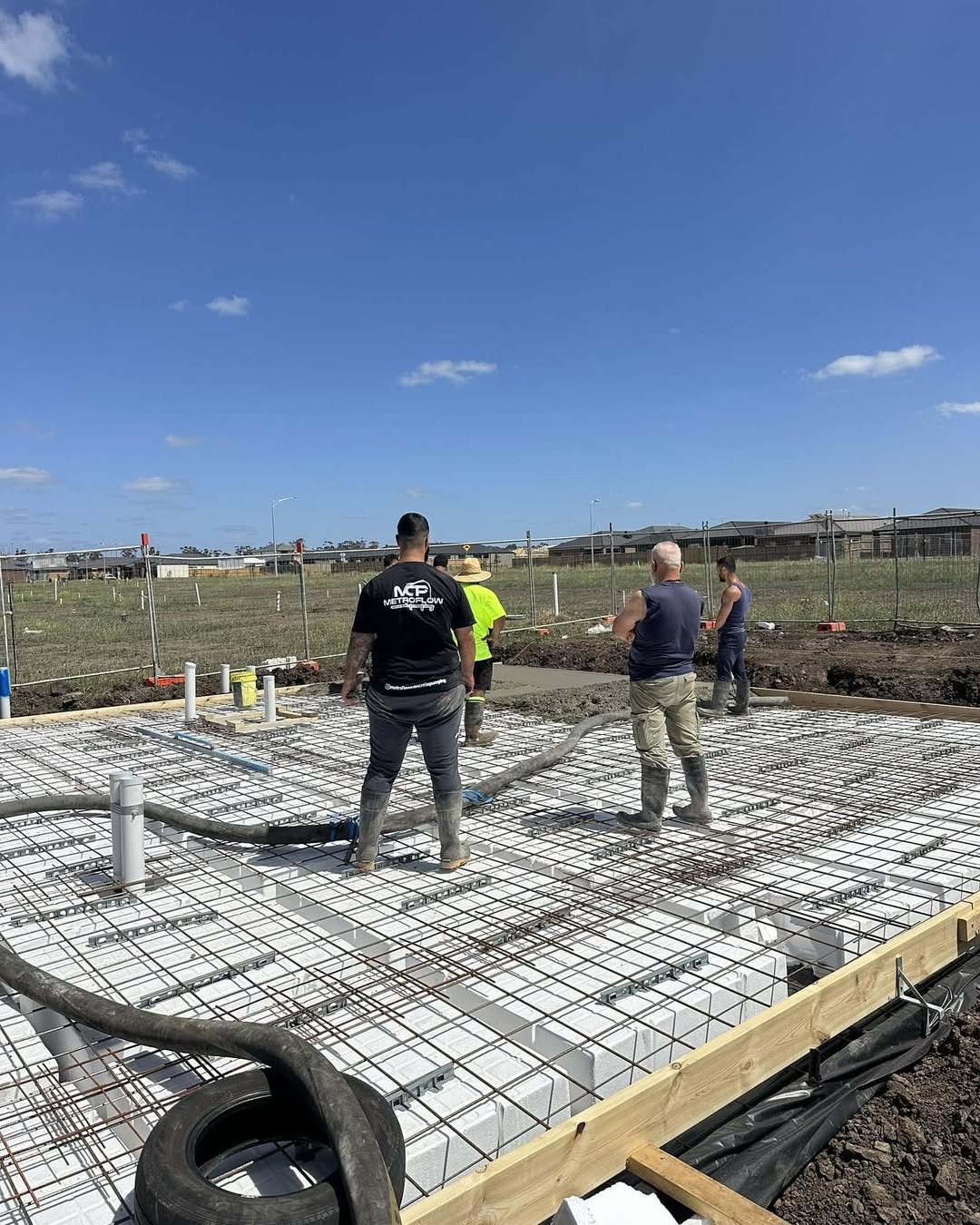
Warehouse developers talk F-numbers — flatness and levelness — because racking aisles and high-lift machinery punish waves and dips. Specifiers focus on laser screeds, finishing crew experience, and mix design. All true. But ask any finisher on a 2000m² Dandenong South pour: if the pump pulses or stalls, no amount of laser skill rescues the pass. Flat floor programs are joint exercises between pump operator, batch plant, and finishing contractor.
What flatness specs demand from placement
Specified FF/FL targets (or successor metrics in project specs) assume continuous placement within a working window — concrete arriving at consistent slump, spread rate steady, no cold strips from intermittent feed. Pump output must match screed speed and crew size. Too fast overwhelms; too slow creates stiff edges before adjacent wet concrete arrives.
Pump operator levers
- Steady output — no surging from hopper intake problems; see NPSH and feed.
- Correct boom or line placement — hose end leads screed path without segregating; segregation shows as local low spots.
- Truck spacing locked — program discipline prevents gaps between loads.
- Mix communicated — SCC or conventional slump-controlled mix changes pump rate limits.
Mix and slump loss over distance
Large warehouse pours may use extended travel time from plant to site. Slump loss mid-pour forces adjustments — operators feel stiffness as pressure climb before finishers do. Pre-pour trial loads and admixture strategy beat crisis calls at load six.
Boom class and reach on big slabs
Open warehouses favour large boom pumps covering bay width from one setup — minimises repositioning cold strips. Repositioning mid-pour is planned, not accidental; each move is a program event. Our boom sizing guide helps match reach to bay geometry.
Joint layout and pour sequencing
Construction joints are engineered — pump placement follows pour strips defined in drawings. Operators pour within strip boundaries finishers can handle before edge stiffening. "Just keep pumping" without strip discipline fails F-numbers at joints.
Testing and liability
Flatness testing happens days later; root cause of failure is often argued backward. Documented pour rate stability, mix tickets, and truck times help — professional pump companies provide pour records on commercial work when requested.
MetroFlow on industrial floors
We pump warehouse and distribution centres across Melbourne's west and south-east industrial belts — experienced operators who've worked beside laser screed crews and know standing still isn't an option when FL matters.
Laser screed coordination
Laser screed operators set pace — pump follows, not leads. Pre-pour huddle aligns m³ per hour target, strip width, and truck spacing. If screed hits joint or edge, pump pauses with line full only within spec window — operator monitors stiffness, communicates before restart.
Joint timing and pump stops
Construction joints are planned stops — not failures. Operators hold partial line volume carefully during joint forming; restarting without reprime check risks segregated first stroke onto fresh joint face. Documented hold times support flatness testing if disputes arise later.
Dowels and joint armouring
Industrial floors with heavy joint armouring need hose placement avoiding displacement of dowel baskets — pump operator follows finisher direction in basket zones. Displaced dowel discovered after pour is structural defect; slow careful placement beats rework cutting floor.
Fibre-reinforced warehouse mixes add wear consideration — steady rate reduces hose end splatter that misaligns surface finish ahead of laser screed pass.
Frequently asked questions
- Does pump guarantee F-numbers? No — flatness is joint outcome; pump provides steady feed enabling finisher work.
- SCC or conventional for FM floors? Spec-driven — both pumpable with correct rate control.
- Strip pour size? Finisher and engineer define — pump follows strip width plan.
- Documentation for testing disputes? Pour records available on commercial jobs when requested.
Distribution centres near Melbourne Airport and the western interstate corridor specify combined flatness and load capacity — pump rate supports laser screed rhythm but doesn't replace proper curing compound application immediately behind the pass. Finisher and operator stay in radio contact through the full bay width.
Third-party flatness surveyors sometimes witness pour rate continuity — pump operator log of steady output supports dispute resolution when testing fails at construction joint attributed to feed interruption rather than finisher technique.
Booking with MetroFlow
Every pour starts with the same information: address or site, estimated volume, mix details if known, and photos of access from street to pour point. We respond with pump type recommendation, boom class if applicable, and all-in pricing without hidden wash or travel surprises on standard Metro jobs. On program work across Victoria, we hold rates and assign consistent operators where repeat quality matters. Whether your job is a Narre Warren house slab, a Geelong warehouse bay, or a Richmond basement wall, the physics of pumping don't change — only the geometry and mix do. Send the details through our quote form or call direct; we'd rather talk you out of the wrong pump than sell you the expensive one. Good pours are boring pours — preparation, honest communication, and operators who've seen your problem before make pour day forgettable in the best way.
FM-rated floor on the program? Share spec and strip plan — we'll align output and scheduling with your finishing contractor before test day embarrassment.