
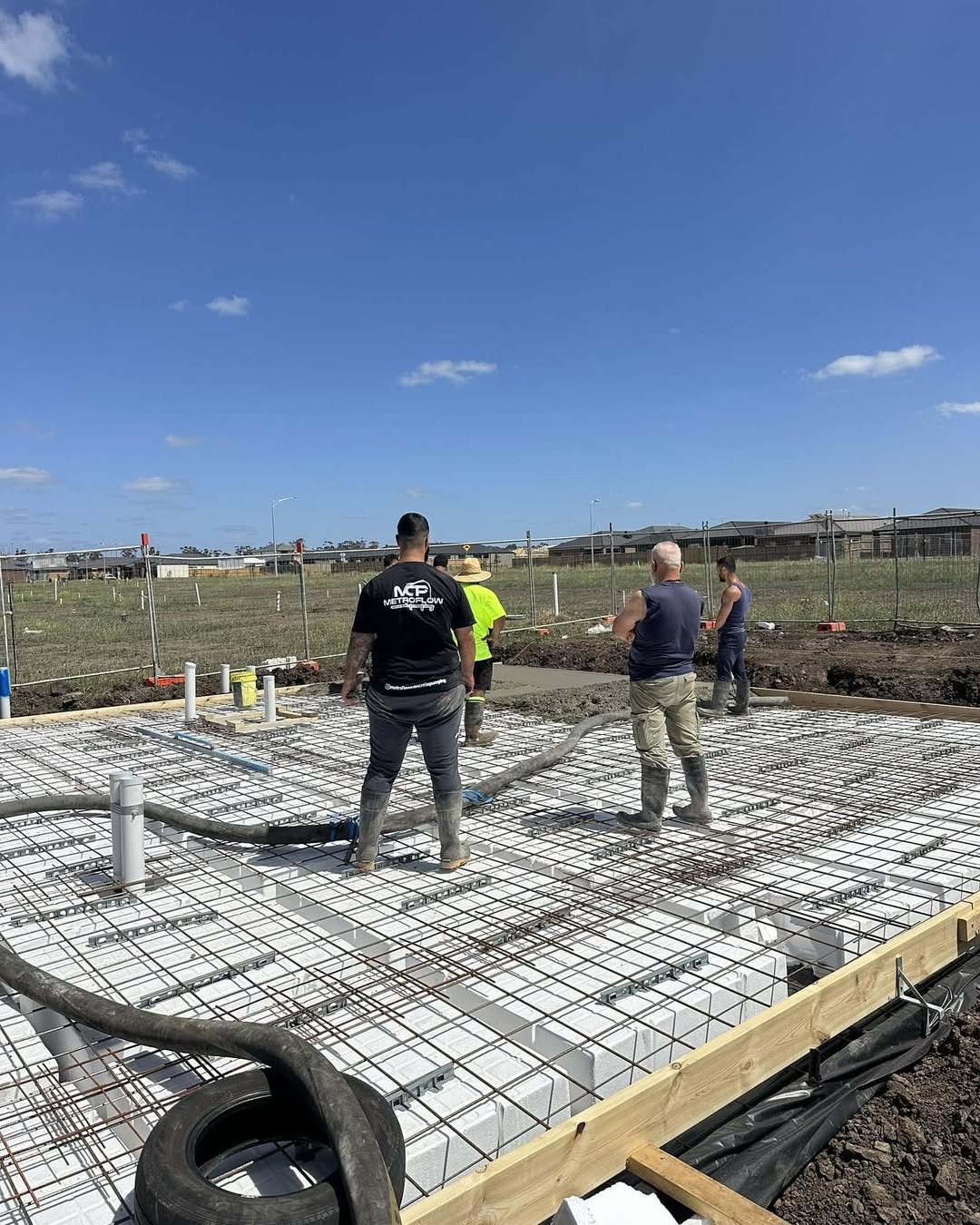
Tilt panel construction concentrates concrete into bursts: massive footing strips and panel bed slabs that must land quickly, monolithically where spec demands, before the crew moves to the next bed. Yards in Melbourne's north and west industrial corridors run to tight pick schedules — a footing pour that stalls doesn't just delay today; it shifts crane picks and erection sequences downstream.
Footing geometry and pump choice
Tilt footings are often long, relatively narrow pours — edge beams, thickened strips, and bed slabs measured in hundreds of cubic metres across a week, not one continuous monolith (though sometimes that too). Boom pumps dominate open yards: truck parks once, boom sweeps the bed, high output keeps pace with multiple agitators. Tight yards or internal strips may need line from a secondary stand.
Volume and truck cycling
Panel footings eat concrete — 80m³ before lunch is normal on larger beds. Pump output and batch plant capacity must align:
- Pre-booked truck intervals — no "call when ready" ambiguity.
- Two pumps on monster beds when program demands — primary plus booster or secondary line.
- Operator coordination with yard foreman on pour direction — always away from the previous cold joint if sectioning unavoidable.
Our commercial scheduling approach is built for this rhythm.
Mix and strength considerations
Footings spec structural MPa with moderate slump for finish where beds must be flat for panel casting. Flatness on bed slabs affects panel quality — waves in the bed telegraph to panels. Steady pump feed helps finishers hit tolerance; pulsing hose doesn't.
Plum concrete appears in mass fill elements adjacent to structural strips — clarify matrix pumping vs plum placement in pre-pour meetings.
Access in industrial yards
Hardstand is usually good — why booms win — but watch soft edges, buried services, and crane pick zones overlapping pump setup. Outrigger pads on compacted gravel — ground bearing still matters even on "industrial" sites.
Cold joints and construction joints
When footing volume exceeds monolithic practicality, construction joint location is engineer-directed — pump placement sequence follows joint strategy, not convenience. Operators need clarity before first stroke.
Documentation and repeat programs
Panel contractors on repeat programs benefit from rate cards, consistent pump classes, and operators who know the yard — MetroFlow holds program pricing where volume justifies it across Melbourne and regional Victoria.
Tilt footings aren't exotic — they're high-volume commercial pumping with zero tolerance for truck queues and amateur scheduling.
Yard logistics — trucks and crane
Panel yards are crowded: stacks, beds, crane paths, delivery trucks. Pump stand and agitator queue need dedicated space in yard layout — not decided when first truck arrives. Foreman marks pump zone and truck holding area in pre-pour walkthrough; operators attend where possible.
Bed flatness feedback loop
Panel quality complaints sometimes trace to bed flatness, not panel mix. Pump feed consistency helps finishers hit bed tolerance — pulsing shows up as panel thickness variation weeks later when panels are picked and stood. Treat bed pours as precision work, not bulk fill.
Curing and bed protection post-pour
Panel beds need curing before panel casting — pump demobilisation doesn't end site responsibility. Fast footings placement without curing plan cracks bed surface; panel finish suffers. Pump operator leaves flat feed evidence in bed quality; concreter owns curing from there.
Night pours on beds under morning panel cast need accelerators and temperature monitoring — winter and summer variants per seasonal guidance.
Frequently asked questions
- Boom or line in panel yard? Open yards boom; constrained yards line — layout decides.
- How many m³ per hour? Matched to bed size and crane/plum sequence — foreman sets target.
- Cold joints in footings? Engineer-directed — pump sequence follows joint plan.
- Program pricing? Available for repeat yard clients — ask with annual volume estimate.
Export panel programs shipping from Victorian yards add tolerance pressure on bed flatness — domestic and export beds often share the same pump crew patterns. Consistent matrix feed across bed types reduces rework before panels reach container inspection.
Panel contractors tracking bed pour data across seasons build internal benchmarks for matrix output rate — MetroFlow aligns with those benchmarks on repeat yards so new operators hit target on first pour of the week, not after adjustment period.
Booking with MetroFlow
Every pour starts with the same information: address or site, estimated volume, mix details if known, and photos of access from street to pour point. We respond with pump type recommendation, boom class if applicable, and all-in pricing without hidden wash or travel surprises on standard Metro jobs. On program work across Victoria, we hold rates and assign consistent operators where repeat quality matters. Whether your job is a Narre Warren house slab, a Geelong warehouse bay, or a Richmond basement wall, the physics of pumping don't change — only the geometry and mix do. Send the details through our quote form or call direct; we'd rather talk you out of the wrong pump than sell you the expensive one. Good pours are boring pours — preparation, honest communication, and operators who've seen your problem before make pour day forgettable in the best way.
Panel yard footing program? Send bed schedules and volumes — we'll align pump class and truck cycle before pick week.